

Sidebar
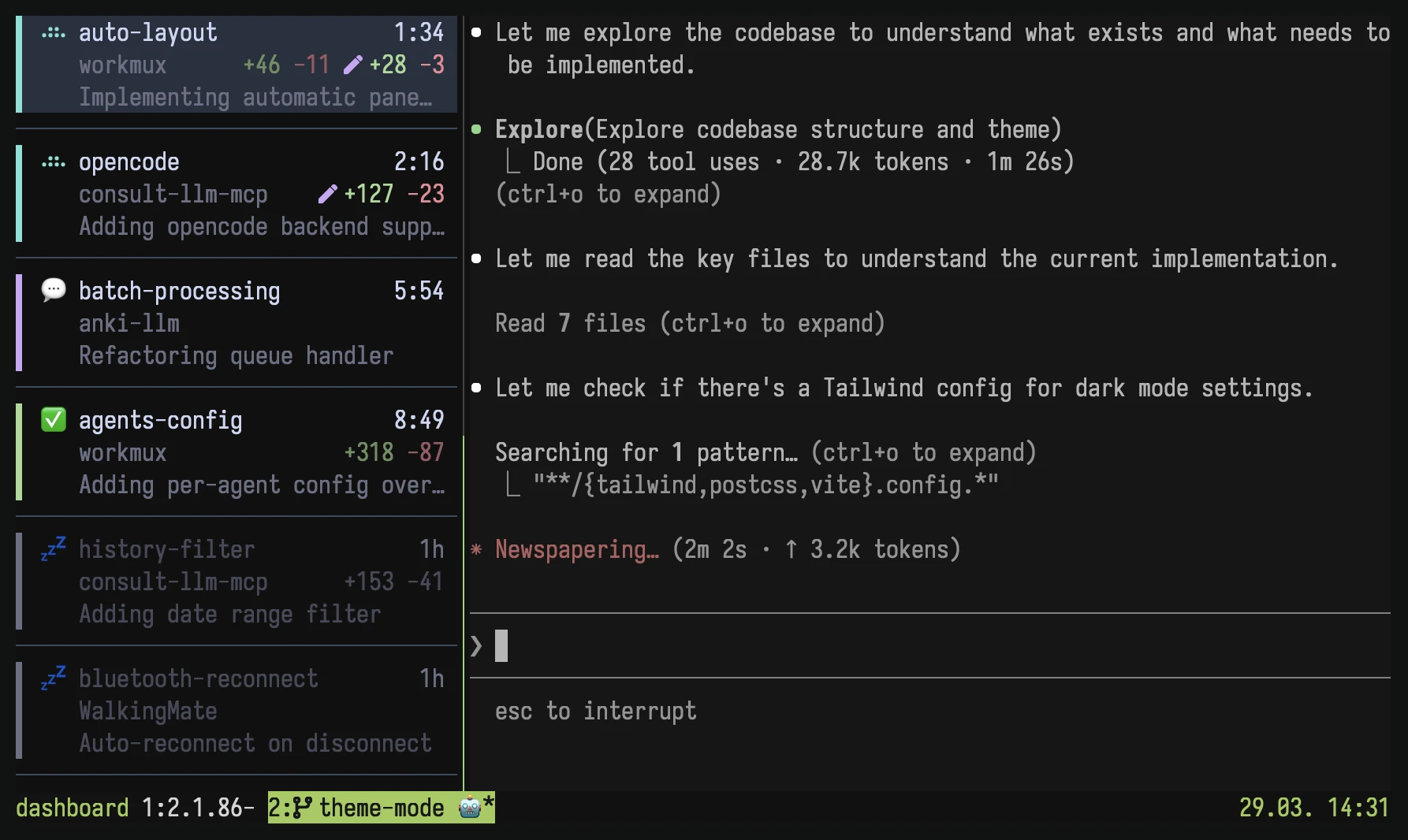
The sidebar provides an always-visible agent overview pinned to the left edge of every tmux window. Unlike the dashboard (which is a full-screen TUI you open on demand), the sidebar stays on screen while you work.
Setup
Prerequisites
The sidebar requires status tracking hooks to be configured and tmux as the backend.
Toggle the sidebar with:
workmux sidebarThe sidebar automatically appears in all existing and newly created tmux windows. Running the command again disables it globally.
Optionally, add a tmux binding for quick access:
bind C-t run-shell "workmux sidebar"What it shows
Each agent is displayed as a tile showing:
- Status icon with spinner animation (working/waiting/done)
- Worktree name and elapsed time since last status change
- Project name and git diff stats (committed + uncommitted lines)
- Agent task description
Configuration
Configure the sidebar in your global ~/.config/workmux/config.yaml or project .workmux.yaml:
sidebar:
  # Width: absolute columns or percentage of terminal width
  width: 40 # absolute columns
  # width: "15%"  # percentage of terminal width

  # Layout mode: "compact" or "tiles" (default)
  layout: tiles
Width defaults to 10% of terminal width, clamped between 25 and 50 columns. When set explicitly, the clamp is removed (minimum 10 columns).
Layout modes
The sidebar supports two layout modes, toggled with v:
- Tiles (default): variable-height cards with status stripe
- Compact: single line per agent
Your preference is persisted across tmux restarts.
Mouse support
Click an agent tile to jump to its pane, or scroll to navigate the list. Requires set -g mouse on in your ~/.tmux.conf.
Keybindings
| Key | Action |
|---|---|
j/k | Navigate up/down |
Enter | Jump to agent pane |
g/G | Jump to first/last |
v | Toggle layout mode |
q | Quit sidebar |
Agent navigation hotkeys
You can switch between agents from any tmux pane using subcommands. These work in the same order shown in the sidebar:
| Command | Action |
|---|---|
workmux sidebar next | Switch to the next agent (wraps) |
workmux sidebar prev | Switch to the previous agent (wraps) |
workmux sidebar jump <N> | Jump to the Nth agent (1-indexed) |
Example tmux keybindings
# Alt+j / Alt+k to cycle agents (no prefix needed)
bind -n M-j run-shell "workmux sidebar next"
bind -n M-k run-shell "workmux sidebar prev"

# Alt+1..9 to jump directly
bind -n M-1 run-shell "workmux sidebar jump 1"
bind -n M-2 run-shell "workmux sidebar jump 2"
bind -n M-3 run-shell "workmux sidebar jump 3"
# ...
How it works
The sidebar is a bit of a hack on top of tmux's pane system, but it works quite well. It uses a daemon + client architecture with event-driven rendering:
Toggle on (
workmux sidebar): creates a narrow tmux pane on the left side of every window using a full-height split, starts a background daemon, and installs tmux hooks.Daemon: a single headless process that polls tmux state every 2 seconds (or immediately when signaled via SIGUSR1). It reads agent state from the filesystem, queries tmux for pane geometry and active windows, then pushes snapshots to all connected sidebar clients over a Unix socket.
Clients: every tmux window gets its own sidebar pane running a separate
workmux _sidebar-runprocess. Each process connects to the shared daemon socket, receives snapshots via a background reader thread, and renders independently. The main thread blocks on a channel, only waking when new data arrives or a spinner tick is needed. Rendering is skipped entirely for inactive windows. This event-driven design keeps CPU usage near zero when idle.Hooks: tmux hooks handle lifecycle events:
after-new-window/after-new-session: automatically adds a sidebar pane to newly created windowswindow-resized: reflows the layout tree to keep the sidebar at the correct width and content panes proportionally balancedafter-select-window/client-session-changed/after-kill-pane: signals the daemon for an immediate refresh
Layout reflow: when the sidebar is added or the terminal is resized, a layout tree parser reads the tmux
#{window_layout}string, scales the content subtree proportionally, and applies the result atomically viaselect-layout. This preserves existing pane proportions (e.g. a 70/30 split stays 70/30).Toggle off: kills all sidebar panes, reflows content panes to fill the freed space, stops the daemon, and removes hooks.
Resource usage
Because tmux has no concept of a pane that persists across all windows, each window runs its own _sidebar-run process. Each one uses roughly 15 MB of resident memory, and the shared daemon (_sidebar-daemon) uses about 16 MB. With five agents running, total memory footprint is around 90 MB. CPU usage is near zero when idle thanks to the event-driven architecture.